Over the Shoulder Shot (OSS)

This shot is framed from behind a person who is looking at the subject. The person facing the subject should usually occupy about 1/3 of the frame.
This shot helps to establish the position of each person, and get the feel of looking at one person from the others point of view.
It's common to cut between these shots during a conversation, alternating the view between the different speakers.
In older 4x3 framing, the person facing away from the camera would typically be cut off just behind the ear. In 16x9 and other widescreen framing, there is more width available and more of this person can be shown (as above).
This shot can be varied quite a bit to include the
shoulder or back of the person facing the subject.
Two Shot
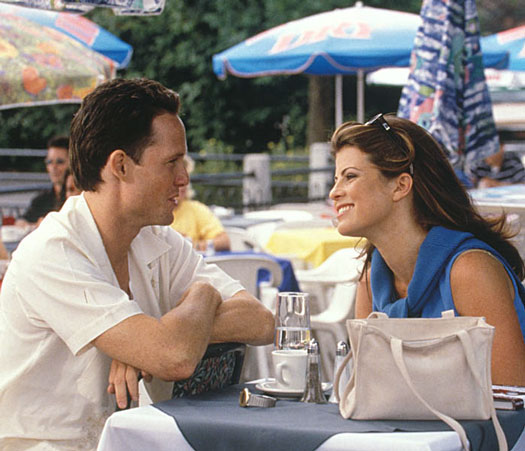
There are a few variations on this one, but the basic idea is to have a comfortable shot of two people. Often used in interviews, or when two presenters are hosting a show.
A "One-Shot" could be a mid-shot of either of these subjects. A "Three-Shot", unsurprisingly, contains three people.
Two-shots are good for establishing a relationship between subjects. If you see two sports presenters standing side by side facing the camera, you get the idea that these people are going to be the show's co-hosts. As they have equal prominence in the frame, the implication is that they will provide equal input. Of course this doesn't always apply, for example, there are many instances in which it's obvious one of the people is a presenter and the other is a guest. In any case, the two-shot is a natural way to introduce two people.
Close Up (CU)

Cut-In (CI)
Like a cutaway, but specifically refers to showing some part of the subject in detail.
Can be used purely as an edit point, or to emphasis emotion etc. For example, hand movements can show enthusiasm, agitation, nervousness, etc.
In the closeup shot, a certain feature or part of the subject takes up most of the frame. A close up of a person usually means a close up of their face (unless specified otherwise).
Close-ups are obviously useful for showing detail and can also be used as a cut-in.
A close-up of a person emphasizes their emotional state. Whereas a mid-shot or wide-shot is more appropriate for delivering facts and general information, a close-up exaggerates facial expressions which convey emotion. The viewer is drawn into the subject's personal space and shares their feelings.
A variation is the choker shot which is typically framed on the subject's face from above the eyebrows to below the mouth.
Wide Shot (WS)

In the wide shot, the subject takes up the full frame. In this case, the boy's feet are almost at the bottom of frame and his head is almost at the top. Obviously the subject doesn't take up the whole width and height of the frame, since this is as close as we can get without losing any part of him. The small amount of room above and below the subject can be thought of as safety room — you don't want to be cutting the top of the head off. It would also look uncomfortable if his feet and head were exactly at the top and bottom of frame.
Extreme Wide Shot (EWS)
In the extreme wide shot, the view is so far from the subject that s/he isn't even visible. The point of this shot is to show the subject's surroundings.The EWS is often used as an "establishing shot" - the first shot of a new scene, designed to show the audience where the action is taking place. It is also useful in scenes where the action is very spread out. For example, in a war movie an extreme wide shot can show the scale of the action.
Weather Shot

In this type of shot the subject is the weather. The sky takes up at least 2/3 of the frame. This type of shot is common in television programs where the weather is of particular interest, e.g. sports shows.
Although the usual purpose of this shot is to show the weather, it is also useful as an establishing shot, for setting the general mood or for overlaying graphics. A weather shot doesn't have to show the sky. Other shots often used to illustrate weather include:
Puddles, drain spouts or any example of rainwater flow.
Trees or anything else blowing in the wind.
People sunbathing.
Snowmen, snowball fights, snow sledding, etc.

No comments:
Post a Comment